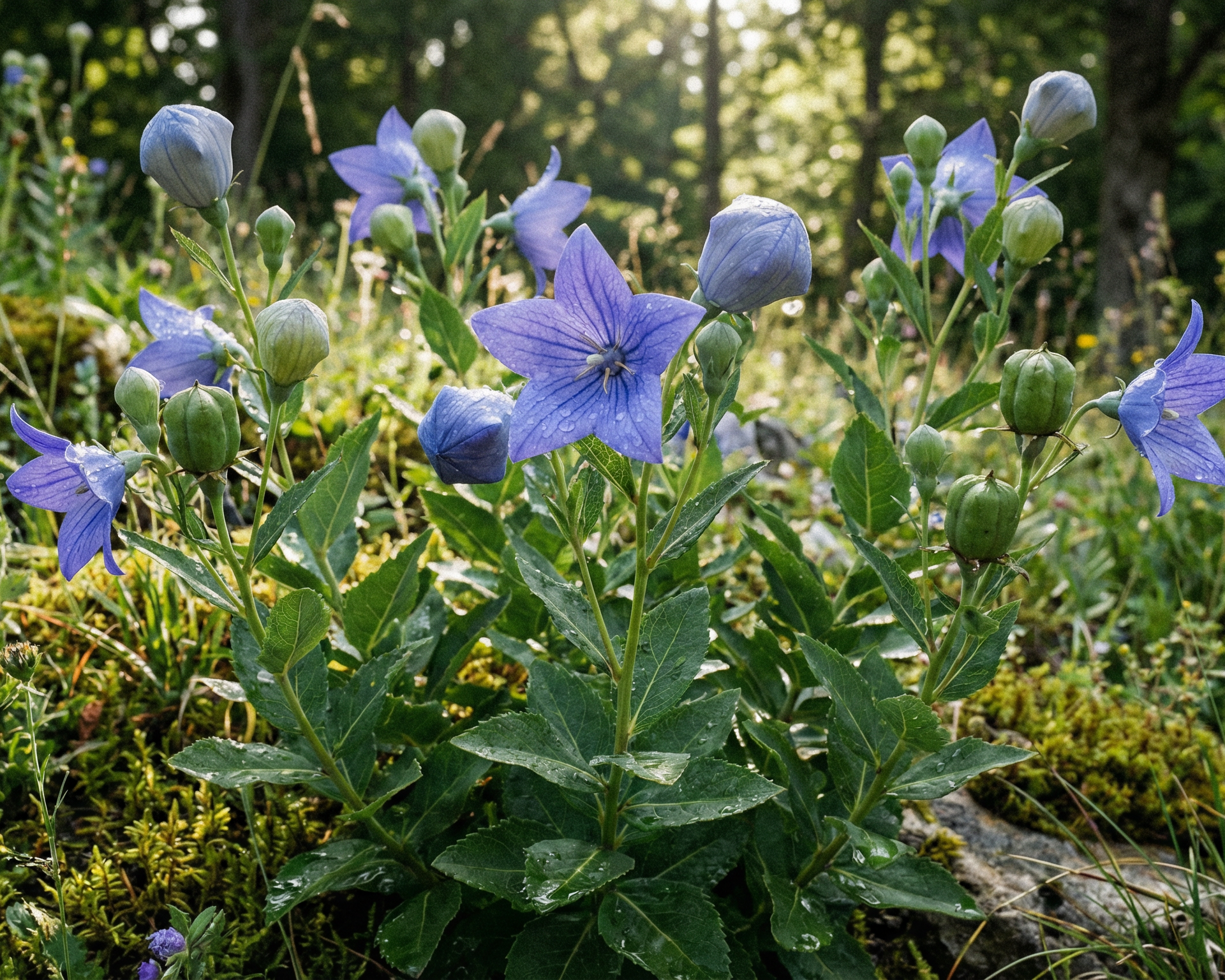
Balloon Flower
Platycodon grandiflorus
11 nurseries nationwide
Compare nurseries
Nurseries with recorded shipping, across all locations. Confirm delivery to your address and availability on the nursery website.
No nursery options match these filters
Try another size or variety, or broaden your location. Options with unconfirmed variety names are included when All varieties is selected.
About Balloon Flower
Platycodon grandiflorus, commonly known as the Balloon Flower, is the sole species in the genus Platycodon. A member of the Campanulaceae family, this herbaceous perennial is native to East Asia, particularly China, Korea, Japan, and the Russian Far East [1] [5]. Its most distinctive feature is the large, unopened flower buds which swell up into a puffy, balloon-like shape before opening into a beautiful, five-pointed, bell-shaped flower, giving the plant its common name [2]. The Balloon Flower typically grows to about 60 cm (24 inches) tall and forms clumps of upright stems with blue-green, ovate leaves. The flowers are most commonly blue to violet, but can also be found in white and pink varieties. Blooming occurs from early to mid-summer, with the potential for reblooming later in the season. The plant thrives in full sun to partial shade and prefers well-drained, loamy soils [3]. Beyond its ornamental value in gardens and as a cut flower, Platycodon grandiflorus holds significant cultural and practical importance. In traditional Chinese medicine, the root of the plant, known as Jie Geng (桔梗), has been used for centuries to treat respiratory conditions like coughs, colds, and sore throats [4]. The root is also consumed as a food item in Korean cuisine, where it is known as doraji and used in salads, pickles, and other dishes. Its adaptability and long-lived nature make it a popular choice for perennial borders and cottage gardens [3] [5]. [1] https://en.wikipedia.org/wiki/Platycodon [2] https://www.missouribotanicalgarden.org/PlantFinder/PlantFinderDetails.aspx?kempercode=c282 [3] https://plants.ces.ncsu.edu/plants/platycodon-grandiflorus/ [4] https://pmc.ncbi.nlm.nih.gov/articles/PMC7073691/ [5] https://www.almanac.com/plant/how-grow-balloon-flowers-colorful-summer-perennials
Plant facts
- Sun
- Full Sun, Partial Sun, Partial Shade
- Water
- Regular, Drought Tolerant
- USDA zones
- 3-8
- Lifecycle
- Perennial