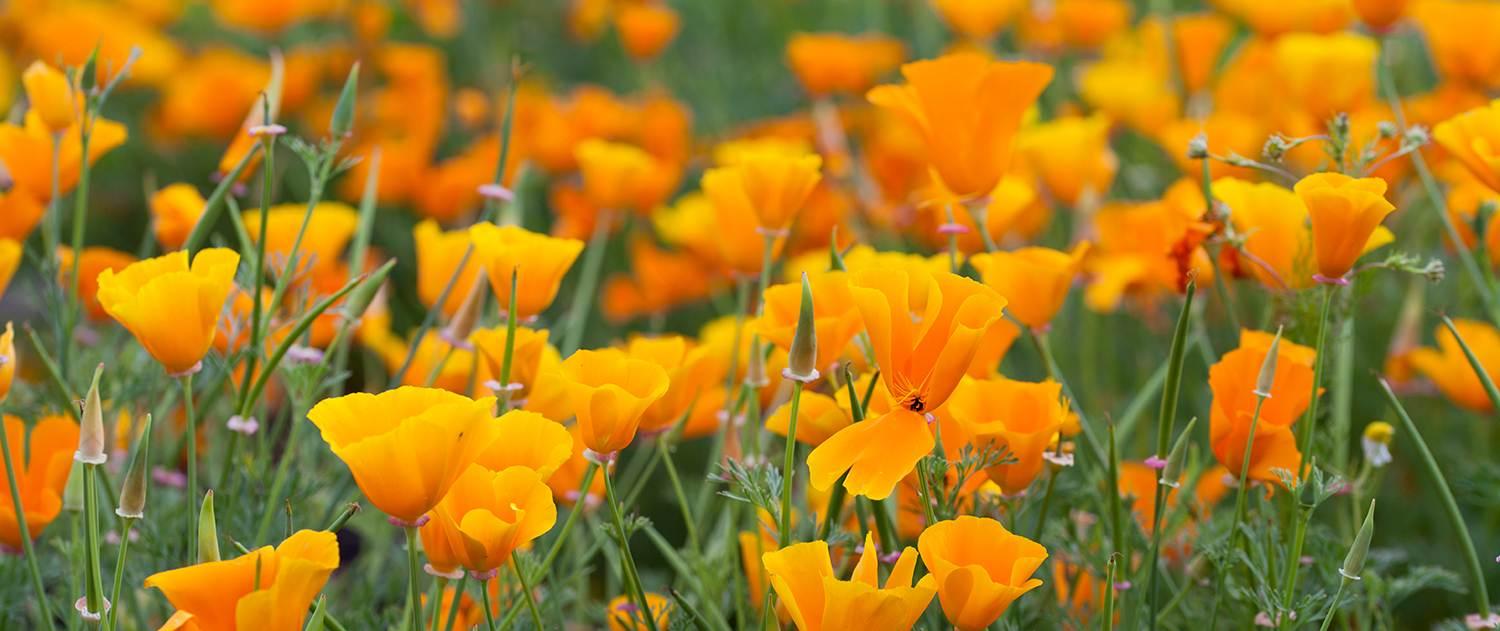
California poppy
Eschscholzia californica
6 nurseries nationwide
Compare nurseries
Nurseries with recorded shipping, across all locations. Confirm delivery to your address and availability on the nursery website.
No nursery options match these filters
Try another size or variety, or broaden your location. Options with unconfirmed variety names are included when All varieties is selected.
About California poppy
The genus Eschscholzia, commonly known as the California poppy, is a group of 12 species of annual or perennial flowering plants in the poppy family (Papaveraceae). Native to Mexico and the western United States, the genus is named after the German-Russian botanist Johann Friedrich von Eschscholtz. The most famous species is Eschscholzia californica, the state flower of California, which is celebrated for its vibrant orange blossoms that cover hillsides and open areas in its native range. California poppies are characterized by their finely divided, blue-green leaves and solitary, four-petaled flowers that range in color from yellow to orange. The flowers are funnel-shaped and close at night or in cloudy weather, reopening in the sunlight. The plant produces long, slender seed pods that split open when mature, forcefully ejecting the small, black seeds. A distinctive feature of the genus is the clear to orange-colored, mildly toxic sap that is exuded from the taproot when cut. These plants are widely cultivated as ornamental garden additions due to their cheerful flowers and ease of care. They thrive in full sun and well-drained, poor soils, making them a suitable choice for dry, warm climates. While they can tolerate some frost, they are typically grown as annuals in cooler regions. Several cultivars have been developed, offering a broader range of colors, including pink, red, and white, with some, like 'Apricot Chiffon' and 'Rose Chiffon', receiving the Royal Horticultural Society's Award of Garden Merit. Beyond their ornamental value, California poppies have a history of use in traditional medicine. Native American tribes utilized the plant for its sedative and analgesic properties, using it to treat a variety of ailments, including toothaches, headaches, and anxiety. Today, it is still used in herbal medicine as a gentle sleep aid and anxiolytic, valued for being a non-addictive alternative to other poppy species. However, it is important to note that the plant is mildly toxic and should be used with caution.
Plant facts
- Sun
- Full Sun
- Water
- Drought Tolerant, Low
- USDA zones
- 4-10
- Lifecycle
- Annual, Perennial
Variety guides
Explore the complete plant collection, including varieties with no nursery listings yet. Counts reflect your location and shopping filters.
- Apricot Chiffon0 nurseries listed
- Buttercream0 nurseries listed
- California Poppy Alba0 nurseries listed
- Carmine King0 nurseries listed
- Dancing Ballerinas0 nurseries listed
- Dusky Rose0 nurseries listed
- Ivory Castle0 nurseries listed
- Mikado0 nurseries listed
- Mission Bells0 nurseries listed
- Orange King0 nurseries listed
- Purple Gleam0 nurseries listed
- Rose Chiffon0 nurseries listed
- Tequila Sunrise0 nurseries listed
- Thai Silk Series0 nurseries listed
- Tropical Sunset0 nurseries listed