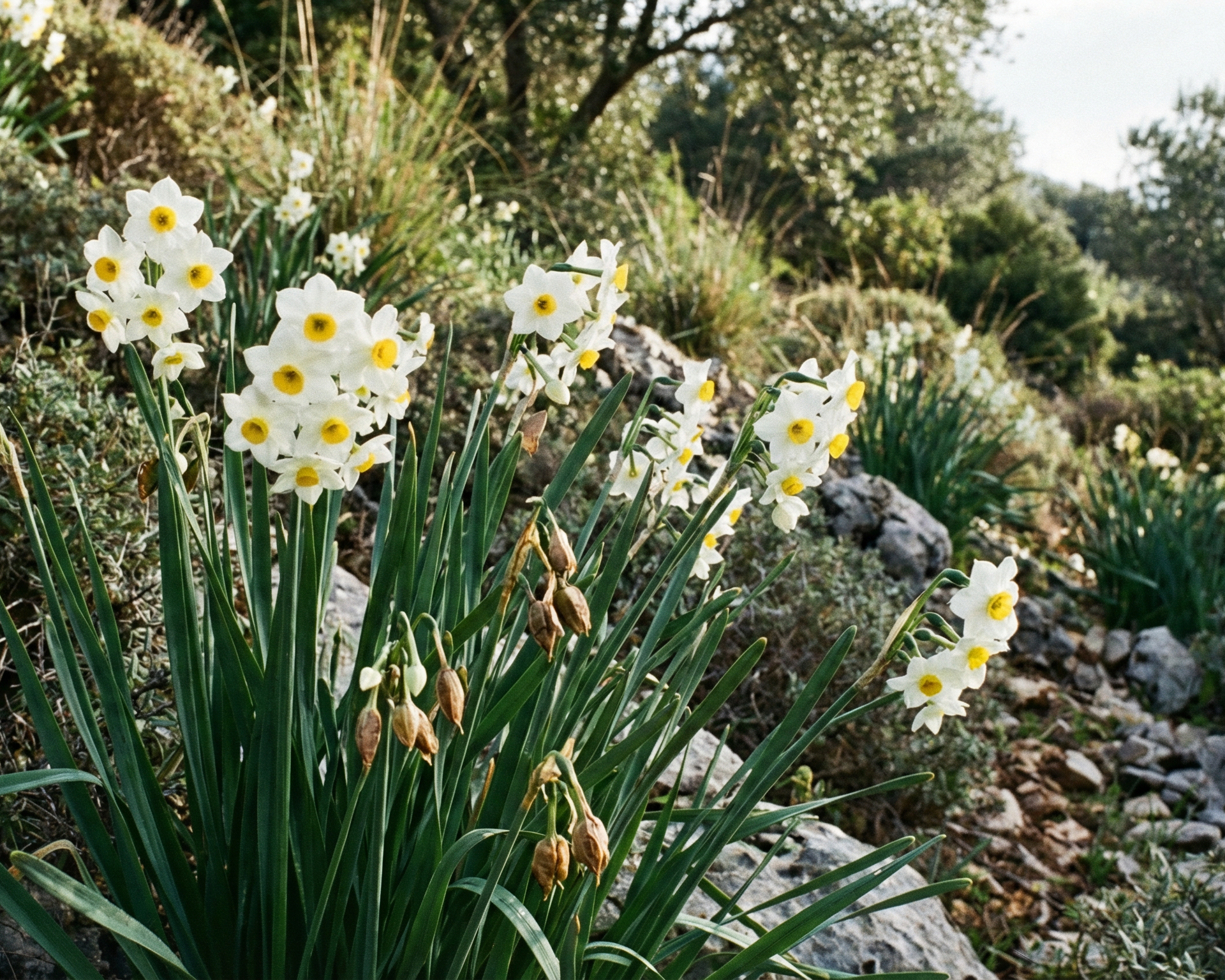
Daffodil
Narcissus spp.
1 nursery nationwide
Compare nurseries
Nurseries with recorded shipping, across all locations. Confirm delivery to your address and availability on the nursery website.
No nursery options match these filters
Try another size or variety, or broaden your location. Options with unconfirmed variety names are included when All varieties is selected.
About Daffodil
Daffodil is the common name for the genus Narcissus, a group of predominantly spring-flowering perennial plants in the amaryllis family (Amaryllidaceae). The name Narcissus is derived from a Greek word meaning "to make numb" and is also linked to the mythological figure Narcissus, who fell in love with his own reflection. Daffodils are native to meadows and woods in Southern Europe and North Africa, with a significant concentration in the Western Mediterranean. They have been cultivated for centuries and have naturalized in many other parts of the world. The flower is a global symbol of spring, renewal, and resilience, and it is the national flower of Wales. The most recognizable feature of the daffodil is its distinct floral structure, which consists of a central cup- or trumpet-shaped corona surrounded by a ring of six petal-like tepals. The flowers are typically yellow or white, but can also be found in shades of pink and orange, with either uniform or contrasting colors between the tepals and the corona. The plants grow from bulbs and have long, narrow, strap-like leaves. They are known for being hardy and low-maintenance, making them a popular choice for gardens and landscapes. Daffodils have a rich history of cultural and medicinal significance. In addition to their ornamental value, they have been used in traditional medicine for various purposes, although it is important to note that all parts of the plant are poisonous if ingested due to the presence of the alkaloid lycorine. In modern medicine, a compound called galantamine, which is extracted from daffodils, is used to treat Alzheimer's disease. Culturally, daffodils are associated with various traditions and symbols. They are a symbol of hope for cancer charities in many countries and are often exchanged as a sign of good fortune during the Chinese New Year. Growing daffodils is relatively easy, as they are adaptable to a wide range of conditions. They thrive in well-drained soil and prefer a location with full sun to partial shade. The bulbs should be planted in the fall to allow for a period of cold dormancy, which is necessary for them to bloom in the spring. Once planted, they require minimal care and will multiply over the years, creating a beautiful and expanding display of color. Their toxicity to animals like deer and squirrels also makes them a resilient choice for many gardens.
Plant facts
- Sun
- Full Sun, Partial Sun, Partial Shade
- Water
- Regular, Drought Tolerant
- USDA zones
- 3-8
- Lifecycle
- Perennial
Variety guides
Explore the complete plant collection, including varieties with no nursery listings yet. Counts reflect your location and shopping filters.
- Barret Browning0 nurseries listed
- British Gamble0 nurseries listed
- Electrus0 nurseries listed
- Falconet0 nurseries listed
- Golden Pearl0 nurseries listed
- Happy Smiles0 nurseries listed
- Ice King0 nurseries listed
- Iwona0 nurseries listed
- Kapiti Peach0 nurseries listed
- Mount Hood0 nurseries listed
- Pheasant's Eye0 nurseries listed
- Pink Bomb0 nurseries listed
- Pom Pom Rose0 nurseries listed
- Pride of Lions0 nurseries listed
- Replete0 nurseries listed
- Tahiti0 nurseries listed
- Tête-À-Tête0 nurseries listed