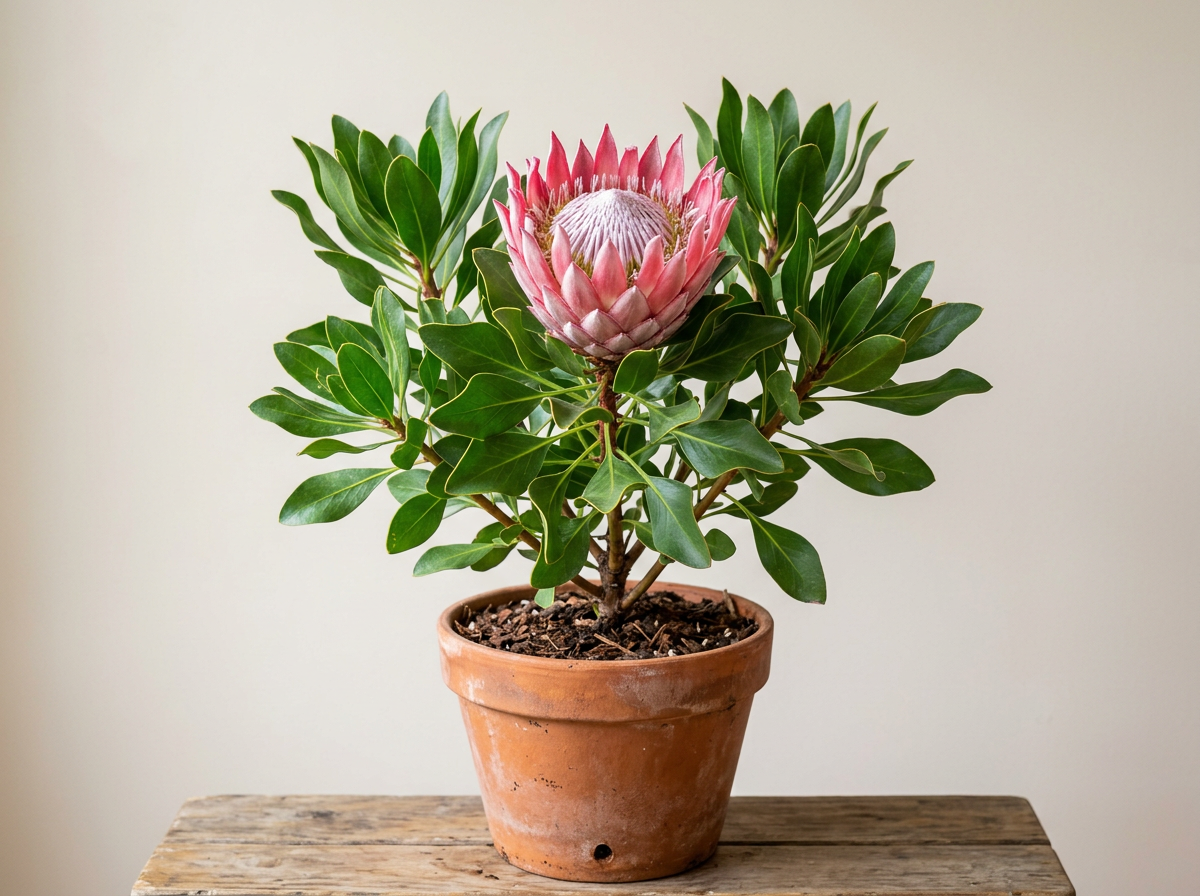
Protea (sugarbush)
Protea spp.
1 nursery nationwide
Compare nurseries
1 nursery · 1 matching option
1 location on the map. Select a marker or a nursery to compare.
Preparing the map…
Your location isn’t saved. Confirm availability and visiting hours with the nursery.
About Protea (sugarbush)
Protea is a genus of flowering plants native to South Africa, where they are also commonly known as sugarbushes. The genus belongs to the Proteaceae family and is its type genus. The name Protea was given by Carl Linnaeus in 1735, who named it after the Greek god Proteus, who could change his form at will. This was in reference to the great diversity of forms found within the genus. The king protea (Protea cynaroides) is the national flower of South Africa and a prominent member of this genus. The most striking feature of the Protea is its large, composite flower head, which is made up of many small, individual flowers (florets) grouped together on a woody receptacle. These flower heads are often surrounded by large, colorful bracts, giving them a cup-like shape. Protea plants are woody shrubs or small trees and are adapted to a Mediterranean climate with dry summers and wet winters. They are pyrophytes, meaning they have strategies to survive wildfires. Pollination is carried out by a variety of animals, including birds, insects, and small mammals, attracted by the copious nectar produced by the flowers. Protea has significant cultural and economic importance. They are widely cultivated in over 20 countries as cut flowers, prized for their unique beauty and long vase life. In traditional medicine, various parts of the plant have been used to treat ailments. The nectar of some species was used as a sugar substitute and to make a cough syrup, while the bark of others was used to treat diarrhea and stomach ulcers. Symbolically, the Protea flower represents diversity, courage, and transformation, reflecting its mythological namesake and its ability to thrive in harsh environments.
Plant facts
- Sun
- Full Sun
- Water
- Drought Tolerant, Low
- USDA zones
- 9-11
- Lifecycle
- Perennial