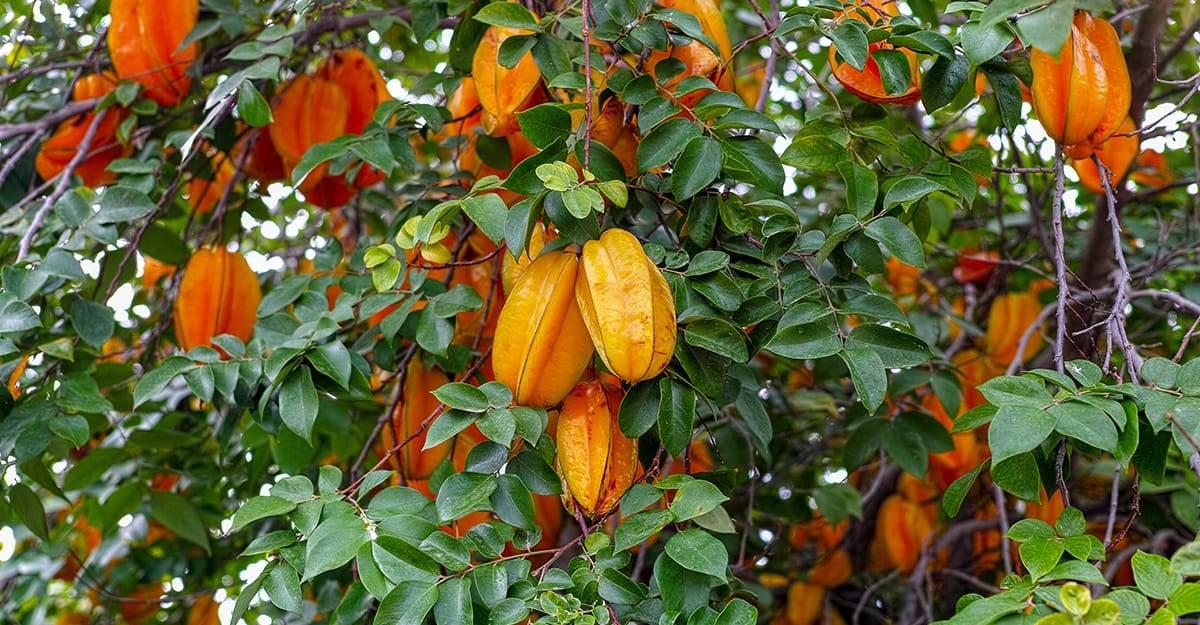
Starfruit
Averrhoa carambola
10 nurseries nationwide · 5 named varieties
Compare nurseries
Nurseries with recorded shipping, across all locations. Confirm delivery to your address and availability on the nursery website.
2 nurseries · 2 matching options
2 locations on the map. Select a marker or a nursery to compare.
Preparing the map…
Your location isn’t saved. Confirm availability and delivery area with the nursery.
About Starfruit
Damasonium, commonly known as Starfruit, is a genus of aquatic perennial herbaceous plants belonging to the Alismataceae family. This genus comprises six species with a widespread yet scattered distribution across various regions, including western North America, Australia, western Europe, and the Mediterranean. These plants are typically found in shallow, still waters or the muddy peripheries of ponds and rice fields, where they can grow as submerged juveniles or with floating and emergent leaves as adults. The key characteristics of the Damasonium genus are quite distinct. The plants grow from a corm-like, compact stem with leaves arranged in a rosette. The leaf blades vary from linear to ovate or elliptic and are supported by long petioles. The inflorescence is a panicle composed of one or more whorls of flowers. The flowers themselves are actinomorphic and bisexual, featuring three green sepals, three white or pink petals with a yellow center, and six to ten carpels arranged in a single whorl. The most notable feature of the genus is its fruit, which is a star-shaped cluster of follicles, giving the plant its common name, Starfruit. While not widely known for extensive culinary or medicinal uses, the Damasonium genus holds significance in botanical and ecological contexts. Its unique star-shaped fruit structure makes it a subject of interest for botanists and plant enthusiasts. Ecologically, some species, such as Damasonium minus, are recognized as weeds in rice paddies, indicating their adaptability and potential to compete with cultivated crops. The dispersal of their seeds and fruits by water and mud contributes to their ability to colonize new wetland habitats.
Plant facts
- Sun
- Full Sun, Partial Sun
- Water
- Regular, High
- USDA zones
- 10-11
- Lifecycle
- Perennial
Variety guides
Explore the complete plant collection, including varieties with no nursery listings yet. Counts reflect your location and shopping filters.
- Arkin0 nurseries listed
- B-100 nurseries listed
- B-170 nurseries listed
- B-20 nurseries listed
- Fwang Tung0 nurseries listed
- Golden Star0 nurseries listed
- Hew-10 nurseries listed
- Kajang0 nurseries listed
- Kary0 nurseries listed
- Lara0 nurseries listed
- Maher Dwarf0 nurseries listed
- Newcomb0 nurseries listed
- Sri Kembangan0 nurseries listed