Cornell Farm
Portland, OR
6 options
Call for pricing
Catalog checked Oct 4, 2026. Confirm availability before visiting.
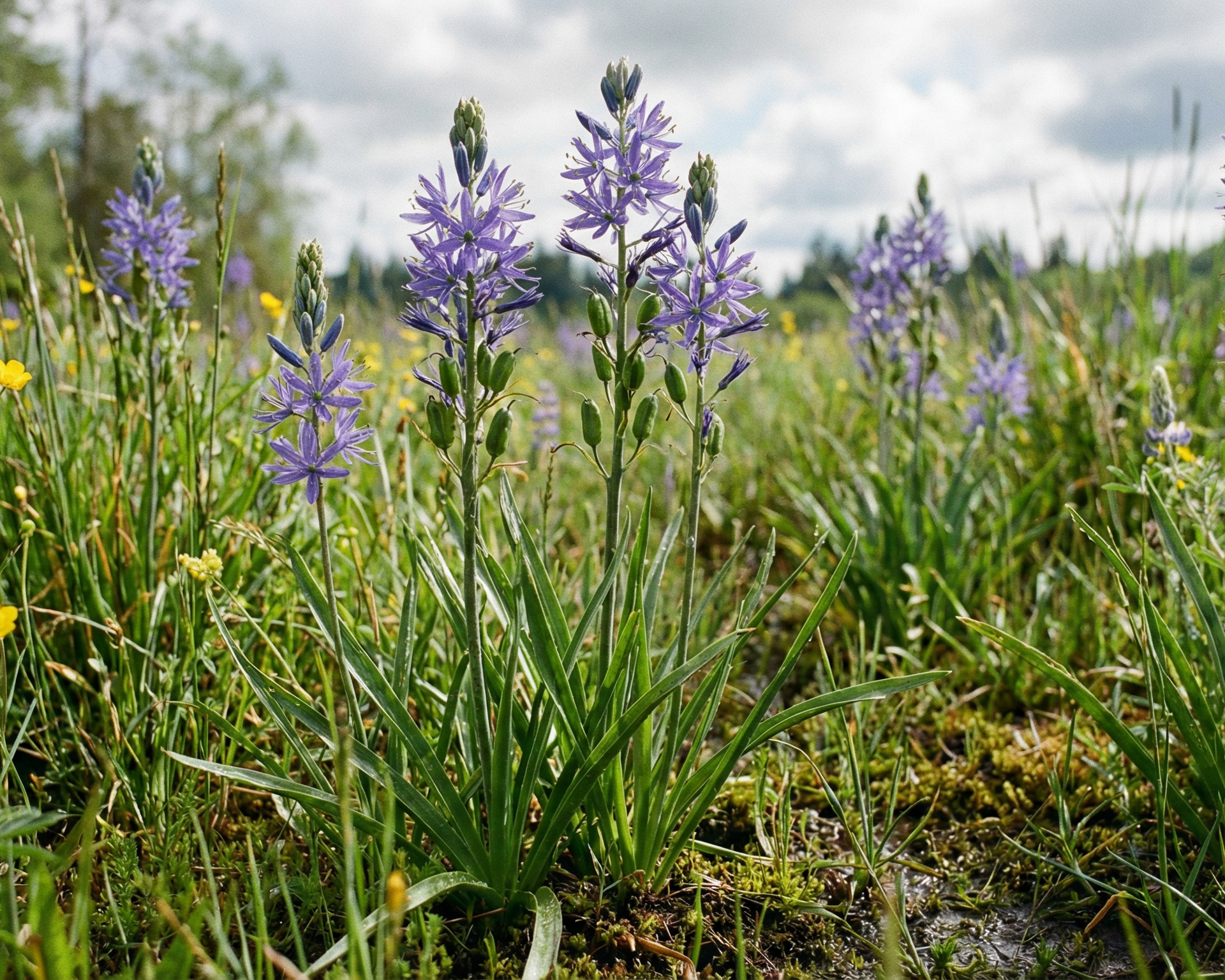
Camassia spp.
3 nurseries nationwide
Choose a city or ZIP to find nearby growers. Showing nationwide listings until you choose an area.
3 nurseries · 20 matching options
Portland, OR
6 options
Call for pricing
Catalog checked Oct 4, 2026. Confirm availability before visiting.
Canby, OR
2 options
Call for pricing
Catalog checked Oct 1, 2026. Confirm availability before visiting.
Albany, OR
12 options
Call for pricing
Catalog checked Oct 1, 2026. Confirm availability before visiting.
Showing 1–3 of 3 nurseries
Camassia, commonly known as Camas, is a genus of perennial bulbous plants native to North America. The genus belongs to the asparagus family, Asparagaceae, and comprises six recognized species. Camas plants are characterized by their linear, grass-like leaves that emerge in the spring, and tall, striking flower stalks that can reach heights of 1 to 4 feet. The flowers, which bloom in late spring, are star-shaped and appear in a raceme, with colors ranging from pale lilac and white to deep purple and blue-violet. These plants are often found in moist meadows and on the edges of woodlands, and they can create a stunning visual display, coloring entire fields with their vibrant blooms. The key characteristics of Camas include their strap-like leaves and the tall, multi-flowered stem that rises above the foliage. The six-petaled flowers are a distinguishing feature, and in some species, like Camassia quamash, five petals curve upwards while the sixth curves downwards. After flowering, the foliage dies back, and the plant enters a period of dormancy. Camas bulbs are an important feature of the plant, not only for propagation but also for their historical use as a food source. The plants are hardy and can tolerate a variety of soil types, including heavy clay, as long as they have adequate moisture during the growing season and a drier period during dormancy. Camas has a rich history of use and cultural significance, particularly among Indigenous peoples of the Pacific Northwest. The bulbs of the Camas plant were a vital food source, harvested in the spring and then pit-roasted or boiled. When cooked, the bulbs have a sweet taste, similar to a sweet potato, due to the presence of inulin. Indigenous communities actively managed and cultivated Camas plots, using controlled burns and other techniques to enhance their growth. Beyond its culinary uses, Camas is also valued as an ornamental plant in gardens. It naturalizes well and is a beautiful, low-maintenance addition to borders, meadows, and cottage gardens, attracting pollinators and providing a link to the region's natural and cultural heritage. For successful cultivation, Camas bulbs should be planted in the fall in a location that receives full sun to partial shade. They thrive in moist, humus-rich, and well-drained soil. While they prefer wet conditions in the winter and spring, they need a drier period after they have finished flowering. The plants can be propagated by dividing the bulb offsets or by seed, and they will slowly spread to form larger clumps over time. Camas is a resilient plant, resistant to deer and rabbits, and generally free of significant pests and diseases, making it an excellent choice for gardeners looking for a beautiful and low-maintenance native plant.