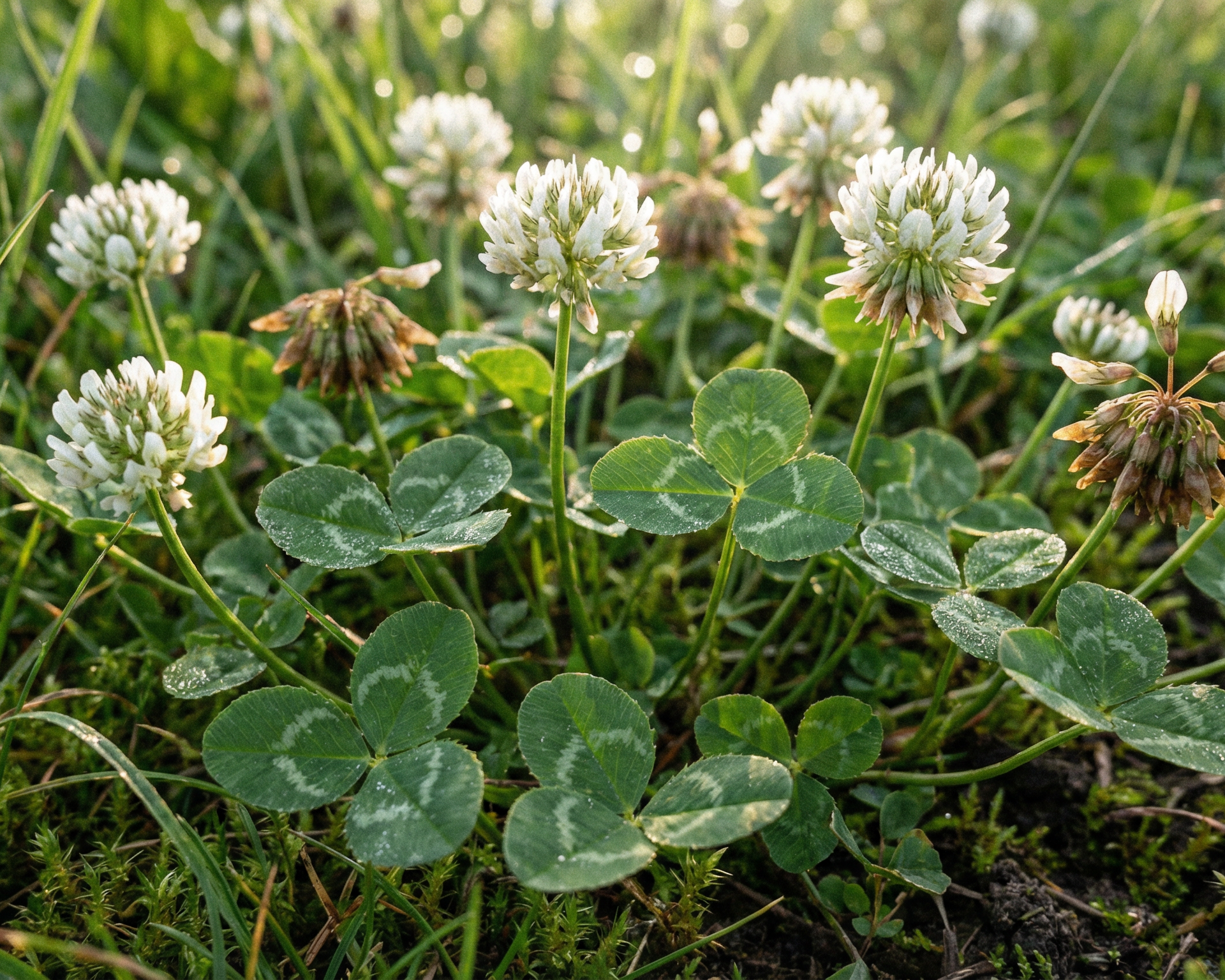
Clover
Trifolium spp.
3 nurseries nationwide
Compare nurseries
Nurseries with recorded shipping, across all locations. Confirm delivery to your address and availability on the nursery website.
No nursery options match these filters
Try another size or variety, or broaden your location. Options with unconfirmed variety names are included when All varieties is selected.
About Clover
Clover, or trefoil, is the common name for plants of the genus Trifolium, which belongs to the legume family, Fabaceae. This genus comprises approximately 300 species of flowering plants, renowned for their distinctive trifoliate leaves, from which the name Trifolium (Latin for "three-leaf") is derived. These plants are distributed worldwide, primarily in the temperate regions of the Northern Hemisphere, but also in mountainous areas of the tropics. While the four-leaf clover is a well-known symbol of good luck, the vast majority of clovers have the characteristic three-leaflet leaves. Clovers are typically small, herbaceous, perennial plants, although some annual species exist. They often have a low-growing, mat-forming habit, spreading through stolons or rhizomes that root at the nodes, which makes them effective ground cover. The flowers are small and fragrant, arranged in dense, spherical or spike-like heads, and come in a range of colors including white, pink, red, and yellow. One of the most significant characteristics of clover is its ability to fix atmospheric nitrogen through a symbiotic relationship with rhizobia bacteria housed in nodules on its roots. This process enriches the soil with nitrogen, a vital nutrient for plant growth. Due to their nitrogen-fixing capabilities, clovers are of great agricultural and ecological importance. They are widely cultivated as a forage crop for livestock, providing high-protein feed, and are also used as a cover crop or green manure to improve soil fertility and structure. Some species, such as red clover (Trifolium pratense) and white clover (Trifolium repens), have a history of use in traditional medicine for a variety of ailments. While not a major food source, the leaves and flowers of some clover species are edible and can be used in salads or as a potherb. The unique scent of their essential oils is also utilized in aromatherapy. Clovers are generally hardy and adaptable plants, capable of thriving in a variety of growing conditions. They typically prefer well-drained soil and a position in full sun to partial shade. Their low-maintenance nature and ability to tolerate mowing make them a common component of lawns and pastures. The presence of clover in a lawn is often seen as a sign of low soil nitrogen, and its ability to thrive in such conditions makes it a valuable, natural soil improver.
Plant facts
- Sun
- Full Sun, Partial Sun, Partial Shade
- Water
- Regular, Drought Tolerant
- USDA zones
- 3-9
- Lifecycle
- Annual, Perennial
Variety guides
Explore the complete plant collection, including varieties with no nursery listings yet. Counts reflect your location and shopping filters.
- AU Robin0 nurseries listed
- AU Sunrise0 nurseries listed
- Cinnamon Plus0 nurseries listed
- Dixie0 nurseries listed
- Durana0 nurseries listed
- Fixation0 nurseries listed
- FreedomMR0 nurseries listed
- Kenland0 nurseries listed
- Mammoth Red0 nurseries listed
- New Zealand White0 nurseries listed
- Regal Ladino Clover0 nurseries listed
- Tibbee0 nurseries listed