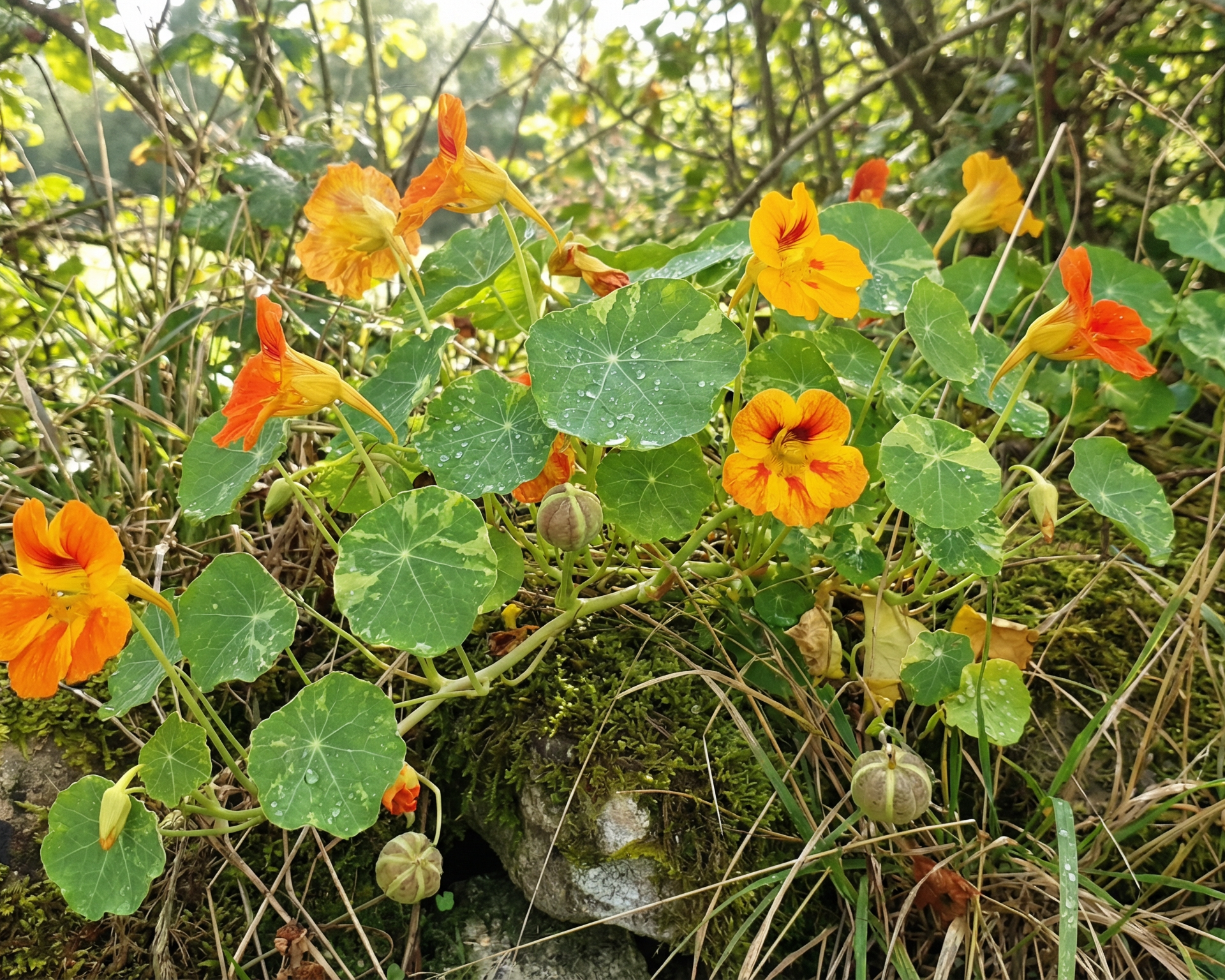
Garden nasturtium
Tropaeolum majus
1 nursery listed
Compare nurseries
Nurseries with recorded shipping, across all locations. Confirm delivery to your address and availability on the nursery website.
No nursery options match these filters
Try another size or variety, or broaden your location. Options with unconfirmed variety names are included when All varieties is selected.
About Garden nasturtium
Nasturtium, the common name for plants in the genus Tropaeolum, is a group of approximately 80 species of annual and perennial herbaceous flowering plants. Native to South and Central America, these plants are the sole genus in the family Tropaeolaceae. The most widely recognized species is Tropaeolum majus, the garden nasturtium. The name "nasturtium" is derived from the Latin words for "nose-twister," alluding to the plant's peppery scent, which is similar to that of watercress. Nasturtiums are celebrated for their vibrant, often intensely colored flowers and unique, shield-shaped (peltate) leaves, where the petiole attaches to the center of the leaf blade, creating an umbrella-like appearance. The flowers are bisexual, zygomorphic, and feature five petals, a funnel-shaped nectar spur, and a spicy fragrance. Their growth habits vary, with some species exhibiting a climbing or trailing nature, making them ideal for trellises and hanging baskets, while others grow as compact, bushy plants suitable for beds and borders. Beyond their ornamental value, nasturtiums are well-regarded for their culinary uses. All parts of the common garden nasturtium (Tropaeolum majus) are edible, offering a peppery flavor reminiscent of watercress. The flowers and leaves are frequently added to salads, while the unopened flower buds and seeds can be pickled to create a condiment known as "poor man's capers." In the garden, nasturtiums are known to attract beneficial insects and hummingbirds, and they are often used as companion plants to deter pests from other crops.
Plant facts
- Sun
- Full Sun, Partial Sun, Partial Shade
- Water
- Regular, Low, Drought Tolerant
- USDA zones
- 3-11
- Lifecycle
- Annual, Perennial
Variety guides
Explore the complete plant collection, including varieties with no nursery listings yet. Counts reflect your location and shopping filters.
- Alaska0 nurseries listed
- Amazon Jewel0 nurseries listed
- Black Velvet0 nurseries listed
- Buttercream0 nurseries listed
- Cherries Jubilee0 nurseries listed
- Climbing Phoenix0 nurseries listed
- Copper Sunset0 nurseries listed
- Creamsicle0 nurseries listed
- Cup of Sun0 nurseries listed
- Empress Of India0 nurseries listed
- Little Firebirds0 nurseries listed
- Moonlight0 nurseries listed
- Purple Emperor0 nurseries listed
- Spitfire0 nurseries listed
- Tip Top Alaska0 nurseries listed
- Tip Top Alaska Salmon0 nurseries listed
- Vanilla Berry0 nurseries listed