
Plants sold by the nurseries, not by us. Confirm availability with the grower.

Cedar
Sun
Full Sun
Water
Regular
USDA zones
5-9

Cedar

Cedrus spp.

9 nurseries nationwideLifecyclePerennial

The genus Cedrus, commonly known as cedar or true cedar, belongs to the pine family (Pinaceae). These majestic coniferous trees are native to the mountainous regions of the western Himalayas and the Mediterranean. Read more

Compare nurseries

9 nurseries · 83 matching options

  • 202 Tree Center - Chadds Ford in Chadds Ford, PA, on siteOn site

    10options

    • Listed as “Cedar – ‘Blue Atlas’ ‘Glauca Pendula’ (Cedrus atlantica)”

      Variety not confirmed15 gal · 60 in tallLowest priced listing

      From $180.00

    Catalog checked Nov 15, 2026. Confirm availability before visiting.
  • Conifer Kingdom in Silverton, OR, on siteOn site

    Conifer Kingdom

    Silverton, OR

    40options

    • Listed as “Cedrus deodara ‘Eisregen’ #2”

      Variety not confirmed2 galOne of 40 nursery listings

      Call for pricing

    Catalog checked Sep 29, 2026. Confirm availability before visiting.

  • Cornell Farm in Portland, OR, on siteOn site

    Cornell Farm

    Portland, OR

    17options

    • Listed as “Cedrus atlantica Sahara Ice 1gal Dwarf Atlas Cedar”

      Variety not confirmed1 galOne of 17 nursery listings

      Call for pricing

    Catalog checked Nov 15, 2026. Confirm availability before visiting.

  • Needham's Nursery in Mt. Juliet, TN, on siteOn site

    Needham's Nursery

    Mt. Juliet, TN

    2options

    • Listed as “CEDAR HORSTMANN BLUE ATLAS (5' B&B) cedrus atlantica 'Horstmann'”

      Variety not confirmedB&B · 60 in tallOne of 2 nursery listings

      Call for pricing

    Catalog checked Nov 15, 2026. Confirm availability before visiting.
  • Nnplant in Modesto, CA, on siteOn site

    Nnplant

    Modesto, CA

    1option

    • Listed as “Cedrus Deodara 1 Gallon Cedrus Deodara Himalayan Cedar Outdoor Live Plant Mr7”

      Variety not confirmedAsk about sizes

      Call for pricing

    Catalog checked Nov 15, 2026. Confirm availability before visiting.
  • Plants they list

    6options

    • Listed as “CEDRUS atlantica ‘Glauca’”

      Variety not confirmedAsk about sizesLowest priced listing

      From $10.00

    Catalog checked Nov 15, 2026. Confirm availability before visiting.
  • Wolke Nursery in Sigel, IL, on siteOn site

    Wolke Nursery

    Sigel, IL

    5options

    • Listed as “Cedrus Atlantica Glauca”

      Variety not confirmed5 galLowest priced listing

      From $80.00

    Catalog checked Nov 15, 2026. Confirm availability before visiting.
Showing 1 to 8 of 9 nurseries

About Cedar

The genus Cedrus, commonly known as cedar or true cedar, belongs to the pine family (Pinaceae). These majestic coniferous trees are native to the mountainous regions of the western Himalayas and the Mediterranean. The genus comprises four closely related species: the Atlas cedar (Cedrus atlantica), the Cyprus cedar (Cedrus brevifolia), the Deodar cedar (Cedrus deodara), and the renowned cedar of Lebanon (Cedrus libani). While some botanists consider these to be geographical variants of a single species, they are generally treated as distinct species. Cedars are highly valued for their ornamental beauty and their durable, aromatic wood, which has been used for thousands of years.

Key Characteristics

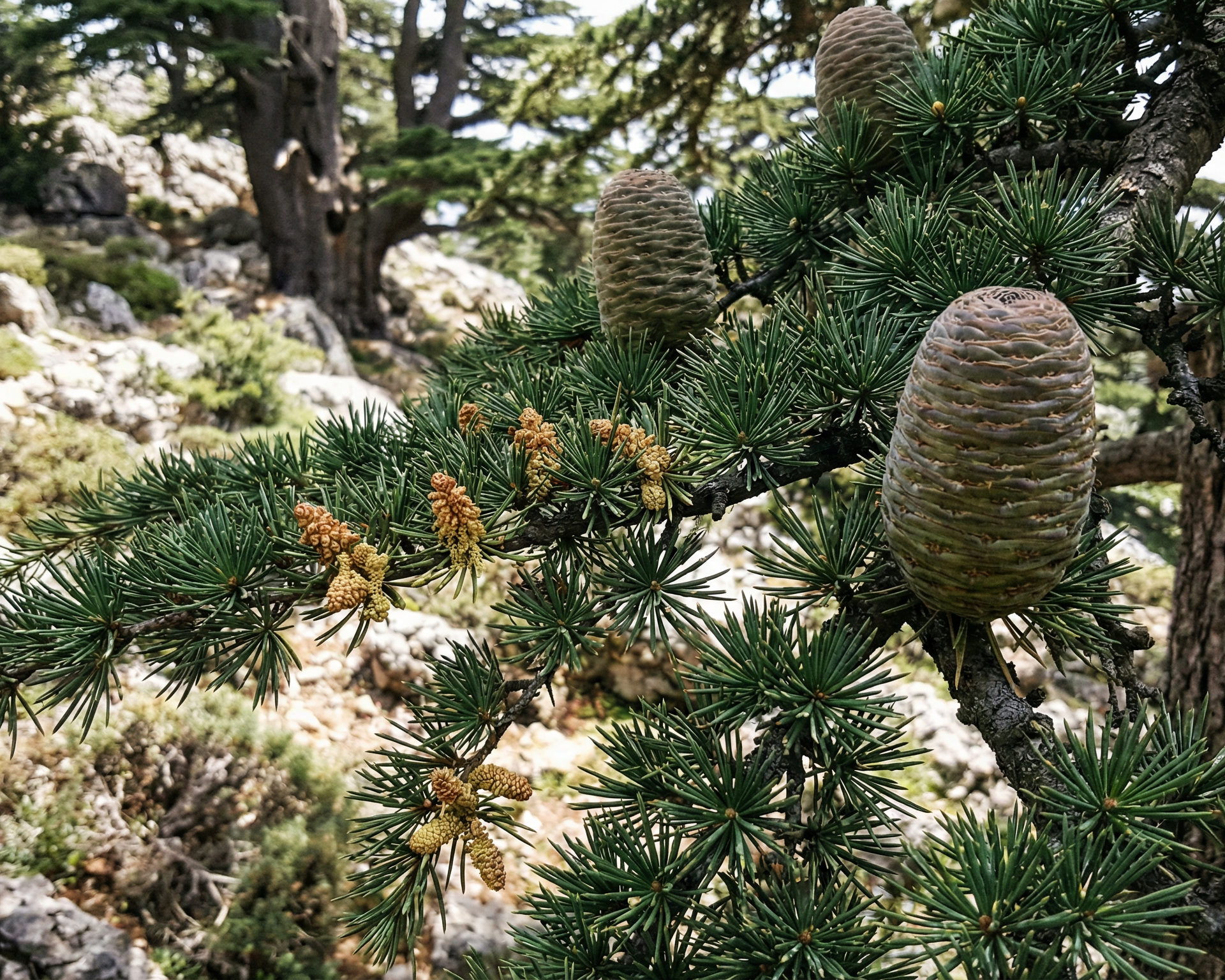
True cedars are large evergreen trees that can reach impressive heights of 30-40 meters, with some specimens growing even taller. They have a characteristic conical shape when young, which becomes broader and more irregular with age, featuring massive, spreading branches. The bark is smooth and dark gray on young trees, becoming brown, furrowed, and scaly as the tree matures. The needle-like leaves are arranged in dense clusters on short spurs and are typically stiff and three-sided. The color of the foliage can range from bright green to a glaucous blue-green. A distinctive feature of the genus is its large, barrel-shaped cones that stand upright on the branches and disintegrate at maturity to release winged seeds.

Uses and Significance

Cedarwood is highly prized for its pleasant aroma, light weight, and natural resistance to decay and insects. Historically, it was used extensively for building temples, palaces, and ships. The cedar of Lebanon, in particular, holds significant cultural and historical importance, being mentioned in ancient texts, including the Epic of Gilgamesh and the Bible. Today, cedars are widely cultivated as ornamental trees in parks, gardens, and private estates around the world. Their majestic form and attractive foliage make them a popular choice for landscaping. The aromatic wood is also used for making chests, closets, and other items where its moth-repellent quality is valued.

Growing Conditions and Care

Cedars thrive in mountainous climates and are well-adapted to a range of conditions. They generally prefer well-drained soil and a sunny location. In their native habitat, they are found at high altitudes, receiving winter precipitation in the form of snow and experiencing dry summers in the Mediterranean, or monsoon rainfall in the Himalayas. While they are relatively hardy, they can be susceptible to certain pests and diseases, particularly when stressed by drought or other environmental factors. When cultivated, they require minimal care once established, making them a low-maintenance option for large landscapes.